← Home · Roadway

Rigid Pavement Design in Brampton: Load Transfer That Lasts

Together, we solve the challenges of tomorrow.

LEARN MORE →

A warehouse expansion off Steeles Avenue last fall hit a snag. The geotech report showed silty clay till with pockets of sand down to three meters, and the owner's original pavement section would have cracked at the first freeze-thaw cycle. Brampton's glacial geology doesn't forgive guesswork. Our team stepped in with rigid pavement design calibrated to the actual subgrade modulus, not a textbook assumption. We ran plate load tests on the compacted fill, checked the moisture sensitivity of the native clay, and delivered a doweled concrete slab specification that the contractor could build without callbacks. The difference between a floor that survives ten winters and one that spalls after two comes down to the design parameters. In a city where the frost line reaches 1.2 meters and truck traffic on arterials like Airport Road never stops, the structural section of a rigid pavement has to account for both environmental loads and repetitive axle stresses. We draw on the Portland Cement Association's thickness design method and supplement it with on-site CBR testing to confirm that the prepared subgrade actually meets the assumed modulus. When the soil profile varies across a site, we specify transition joints and variable reinforcement to keep the slab working as a unit.

A well-designed rigid pavement in Brampton's climate distributes wheel loads across a stiff slab so the subgrade never sees stress beyond its elastic range.
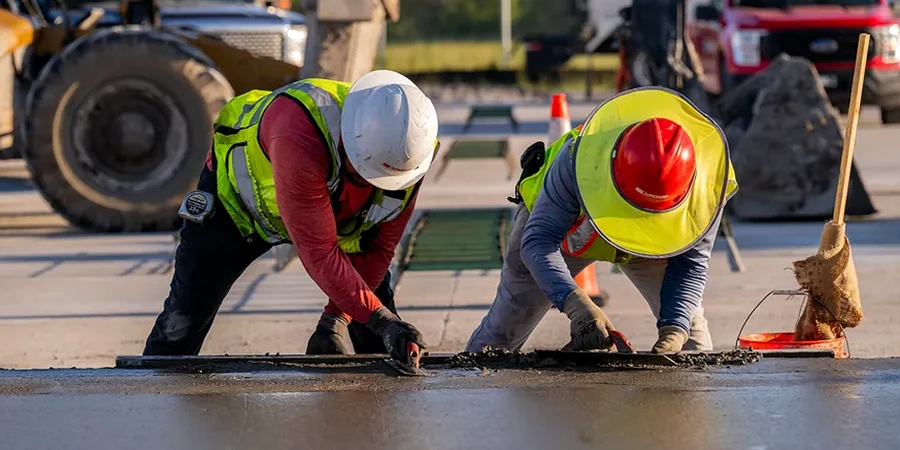
How we work

Compare a distribution center built on the limestone plain near Castlemore with a cold storage facility down in the Etobicoke Creek valley. The Castlemore site sits on dense Halton Till; the valley site has alluvial silts and a higher water table. Both need rigid pavement, but the joint spacing, dowel diameter, and base course thickness won't be the same. That's the kind of distinction that matters in Brampton, where a single industrial subdivision can cross two different surficial geology units. Our rigid pavement design process starts with classifying the subgrade according to the AASHTO system and measuring the modulus of subgrade reaction. We specify concrete mixes that perform under the freeze-thaw exposure class defined in CSA A23.1, with air void parameters verified on cores pulled from trial placements. For heavily loaded truck lanes, we model the edge stresses using finite element analysis and add thickened edges or a stabilized base where the numbers demand it. The joint layout is never a standard copy-paste grid: we align contraction joints with column lines, isolate slabs around dock levelers, and detail construction joints so they don't become crack initiators. A plate load test on the finished base course gives us the confirmation that the design assumptions hold, and if the numbers don't match, we adjust before the concrete goes down.
Rigid Pavement Design in Brampton: Load Transfer That Lasts
Technical reference image — Brampton

Local considerations

In Brampton, we frequently see rigid pavements that fail because the designer treated the subgrade as a uniform layer when it isn't. A test pit on one side of the building shows dry clay; fifty meters away, the same stratum is saturated silt. If the slab thickness is based on the best-case k-value, the weak zone will pump fines at the joints within the first two years. Another recurring issue is joint detailing around interior columns. Without isolation joints, the column restrains slab movement and causes radial cracking that no amount of sealant can fix. The freeze-thaw cycling from November through March opens hairline cracks into full-depth fractures if the concrete's air void system falls below 5 percent. Our team specifies air content per CSA exposure class C-2 and verifies it with petrographic analysis on cores. The third risk is load transfer at construction joints. A smooth dowel without proper alignment binds the slab and spalls the concrete around the bar. We detail dowel baskets with expansion caps and check alignment before the pour, because fixing a locked joint in an operating warehouse costs ten times what the basket cost.

Need a geotechnical assessment?

Reply within 24h.

Email: contact@geotechnicalengineering.co

Explanatory video

Typical values

ParameterTypical value
Concrete compressive strength (28-day)32-40 MPa per CSA A23.1
Modulus of subgrade reaction (k-value)35-80 MPa/m typical for Halton Till
Flexural strength (modulus of rupture)4.0-5.0 MPa
Joint spacing (plain jointed)3.5-5.0 m per PCA guidelines
Base course thickness150-250 mm (granular A or cement-treated)
Dowel bar diameter25-38 mm depending on slab thickness
Maximum aggregate size19-25 mm for pumpable mixes

Other technical services

01

Concrete pavement thickness design

PCA and AASHTO-based structural design for truck lanes, loading docks, and container yards. We determine slab thickness, reinforcement, and joint layout using your actual subgrade k-value and traffic spectrum.

02

Subgrade evaluation and plate load testing

Field measurement of the modulus of subgrade reaction using circular bearing plates per ASTM D1196. We correlate results with laboratory CBR and identify soft zones that need over-excavation or stabilization.

03

Joint detailing and construction oversight

Contraction, construction, and isolation joint plans aligned with column grids and traffic patterns. We inspect dowel alignment, base course compaction, and concrete placement to keep the design intent intact.

Applicable standards

CSA A23.1:19 Concrete materials and methods of concrete construction, ASTM D1196 / D1196M Standard Test Method for Nonrepetitive Static Plate Load Tests of Soils and Flexible Pavement Components, PCA EB204P Thickness Design for Concrete Highway and Street Pavements

Common questions

What does rigid pavement design cost for a typical industrial lot in Brampton?
How deep do you evaluate the subgrade for a rigid pavement?

We typically investigate down to 2.5 to 3 meters below the proposed slab elevation. That captures the active zone for stress influence and lets us check for compressible layers that could cause differential settlement. In Brampton's glacial terrain, we often encounter interbedded silt and clay lenses, so our investigation uses test pits and dynamic cone penetrometer soundings to build a continuous profile rather than relying on isolated boreholes.

Do you handle both the design and the field testing?

Yes, we provide the full package: subgrade investigation, laboratory classification of the soils, modulus of subgrade reaction determination, concrete mix review, pavement thickness design, and construction-phase plate load testing on the prepared base course. This keeps the design assumptions connected to the actual ground conditions, which is critical when you're working with variable glacial deposits like those across Brampton.

Location and service area

We serve projects across Brampton and surrounding areas.

View larger map