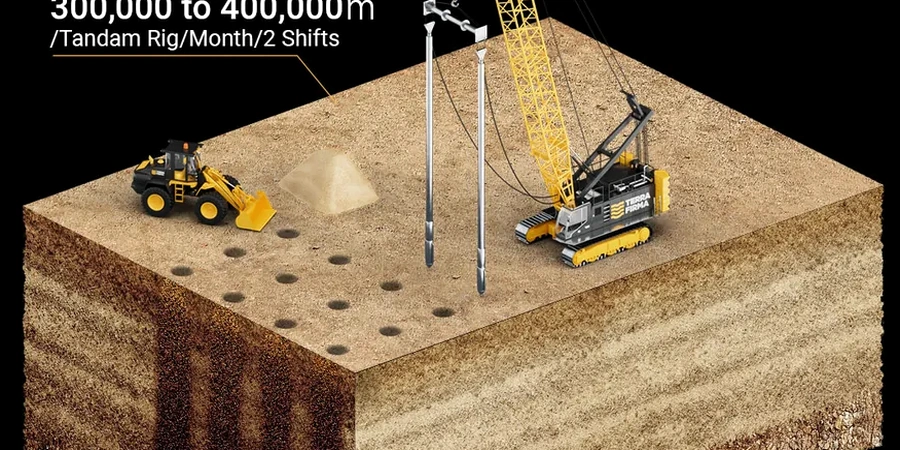
Brampton sits at roughly 230 meters above sea level on a thick sequence of glacial till and outwash deposits left by the Ontario Ice Lobe. More than 650,000 people now live here, and the pressure to build on marginal land keeps rising. The Halton Till can be dense, but the overlying sands and silty sands in the Etobicoke Creek and Credit River corridors are often loose to very loose below the water table. Vibrocompaction design in Brampton addresses exactly this: deep densification of granular soils that would otherwise settle excessively under structural loads or liquefy during a seismic event. A CPT test before treatment gives us the pre-improvement cone resistance profile, and we cross-check it against post-treatment data to confirm the target relative density has been reached.
Loose sand below the water table does not fix itself. Vibrocompaction turns a settlement-prone deposit into a dense, engineered foundation material.
Local considerations
Southern Ontario winters bring repeated freeze-thaw cycles that can heave untreated fills, while spring melt and summer thunderstorms saturate the ground and raise the water table in a matter of hours. In Brampton, the water table often sits within 2 to 4 meters of the surface across the low-relief plains. If loose sand below that level is not densified before construction, the combination of seasonal saturation and structural loading triggers differential settlement that cracks slabs, tilts footings, and distorts pavement within the first three years. Liquefaction is a secondary but real concern: the NBCC assigns a seismic hazard to the region, and loose saturated sands can lose strength under cyclic loading. Our vibrocompaction design directly mitigates both settlement and seismic risk by increasing the soil's relative density and lateral stress state, reducing the potential for pore pressure buildup and ground deformation during an earthquake.
Common questions
How do you know if a Brampton site is suitable for vibrocompaction?
The soil must be predominantly granular with less than 15 percent fines passing the No. 200 sieve. We run grain size tests and CPT soundings first. If the deposit is too silty or clayey, vibrocompaction will not work and we recommend stone columns or a different ground improvement method.
What depth can vibrocompaction reach in the Brampton area?
We routinely treat granular deposits from 3 meters down to 20 meters below grade. The Halton Till acts as a natural bearing layer at depth; we design the treatment to extend from the base of the loose sand down to refusal on the till or to the maximum depth of the vibroflot.
How long does a typical vibrocompaction job take?
A single vibroflot can treat 200 to 400 square meters per shift depending on depth and grid spacing. A typical 2,000-square-meter building footprint in Brampton takes three to five working days for the treatment phase, plus one day of post-treatment CPT verification.
What does vibrocompaction design cost for a project in Brampton?
Does vibrocompaction eliminate liquefaction risk completely?
It reduces the risk dramatically by densifying the soil to a state where pore pressure buildup is minimal. We design to a minimum relative density of 70 percent, which typically corresponds to a factor of safety above 1.3 against liquefaction triggering under the NBCC design earthquake.