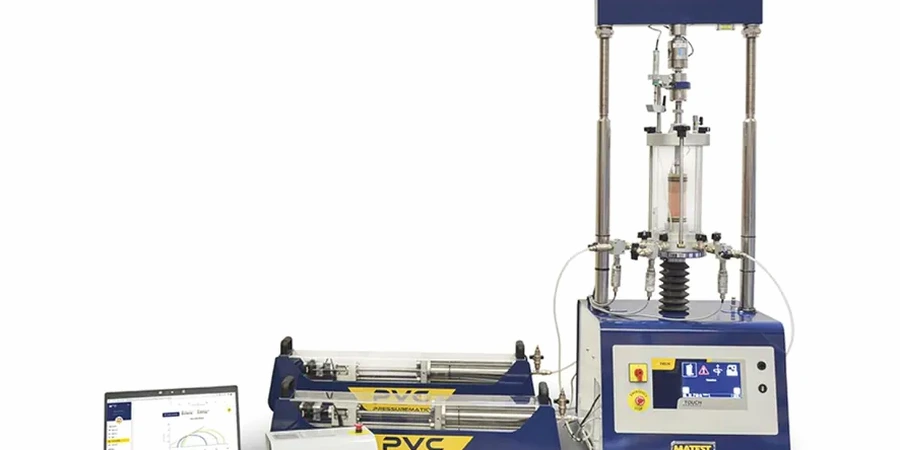
Any geotechnical engineer working in Brampton's residential and industrial corridors knows the drill: you hit the Halton Till and the real design questions start. This dense, silty-clay glacial deposit governs bearing capacity and settlement behavior across most of the city, from Castlemore to Mount Pleasant. Getting the shear strength parameters right is not a formality; it is the difference between a cost-effective foundation and an overdesigned concrete mass. The triaxial test provides the consolidated-undrained and drained strength envelopes that standard penetration tests simply cannot deliver. For projects involving deep excavations near the Etobicoke Creek floodplain or retaining structures along Highway 410, we combine the CPT profiling with triaxial stages to calibrate undrained shear strength profiles against pore pressure dissipation data, ensuring the numerical model reflects actual ground response rather than textbook correlations.
The triaxial test converts a soil sample into a stress-strain curve that governs how Brampton foundations perform under load for decades.
Common questions
What is the typical turnaround time for a triaxial test program in Brampton?
A standard three-specimen CU triaxial suite with pore pressure measurement typically requires 10 to 14 business days from sample extrusion to final report. This includes back-pressure saturation, consolidation, and strain-controlled shearing stages per ASTM D4767. Expedited processing can reduce the timeline for time-sensitive Brampton construction schedules.
How much does a triaxial shear strength testing program cost for a project in Brampton?
When do I need a triaxial test instead of an SPT-based correlation?
Triaxial testing becomes essential when the project involves deep excavations, slope stability at angles steeper than 2H:1V, or structures imposing high foundation loads on the Halton Till. SPT correlations provide preliminary estimates, but the triaxial test measures the actual effective stress friction angle and cohesion intercept needed for finite element or limit equilibrium models that Brampton municipal reviewers require for excavation permits.
What sample quality is required for reliable triaxial results?
Undisturbed Shelby tube samples with a minimum diameter of 70 mm and an area ratio below 10 percent are the standard. Samples must be sealed immediately after extrusion, transported in foam-lined boxes, and stored at in-situ moisture content. Disturbed or desiccated samples produce unreliable strength envelopes and should be rejected during the logging phase before testing begins.
Can triaxial testing simulate the stress path of a Brampton excavation?
Yes, anisotropic consolidation and stress path triaxial testing can replicate the unloading sequence that occurs during a trench excavation or basement dig. By reducing the confining stress while holding the axial load, the test measures the soil stiffness and pore pressure response along a realistic K0-unloading trajectory, providing direct input for wall deflection predictions.